
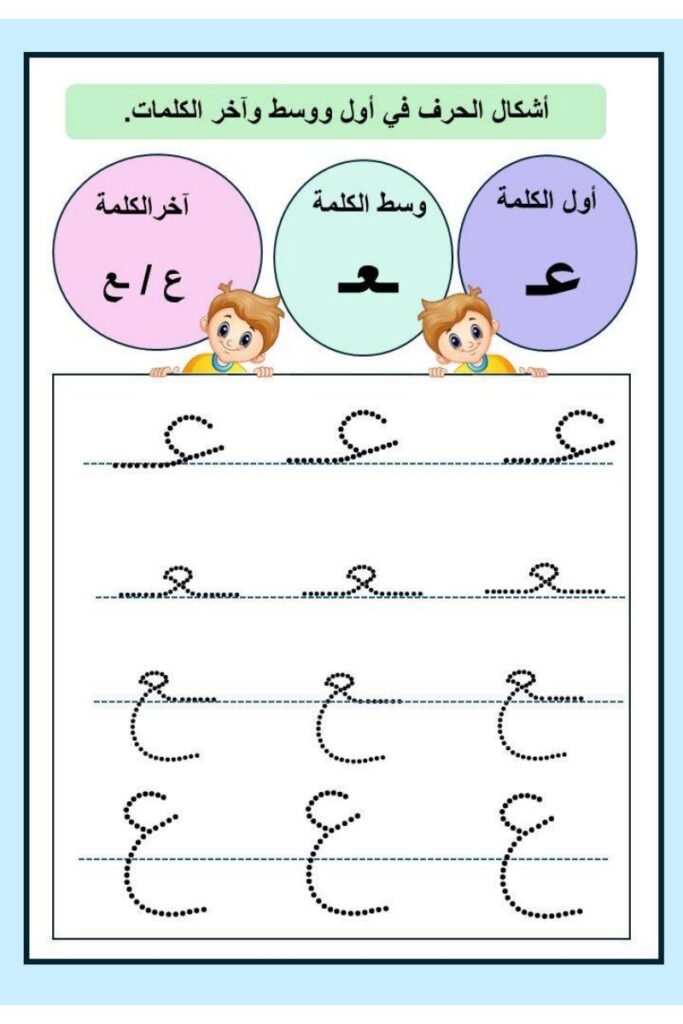
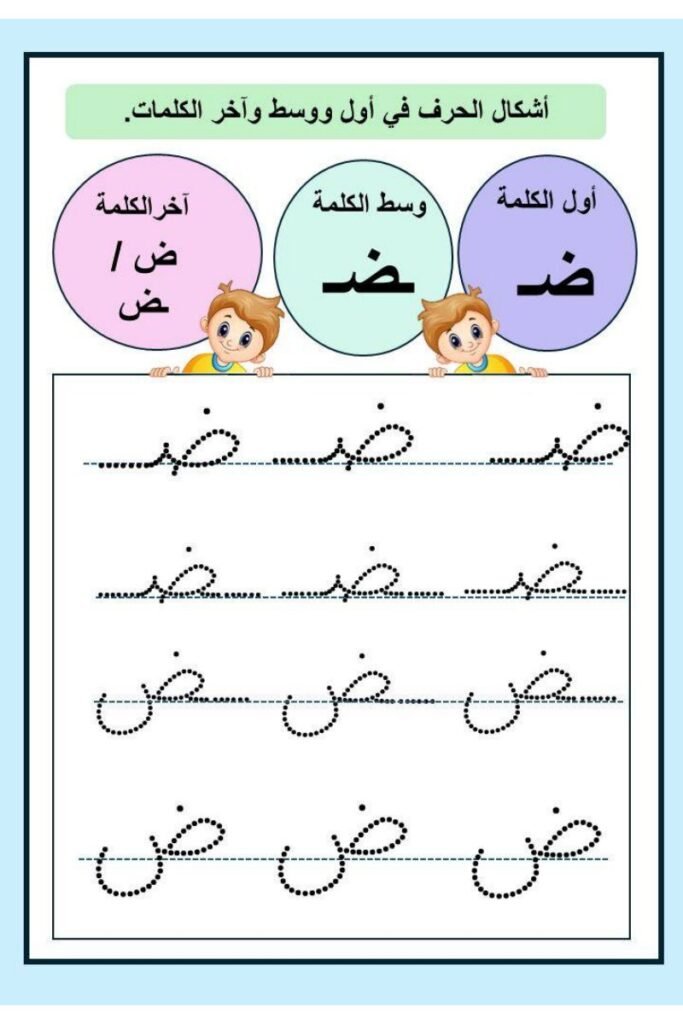
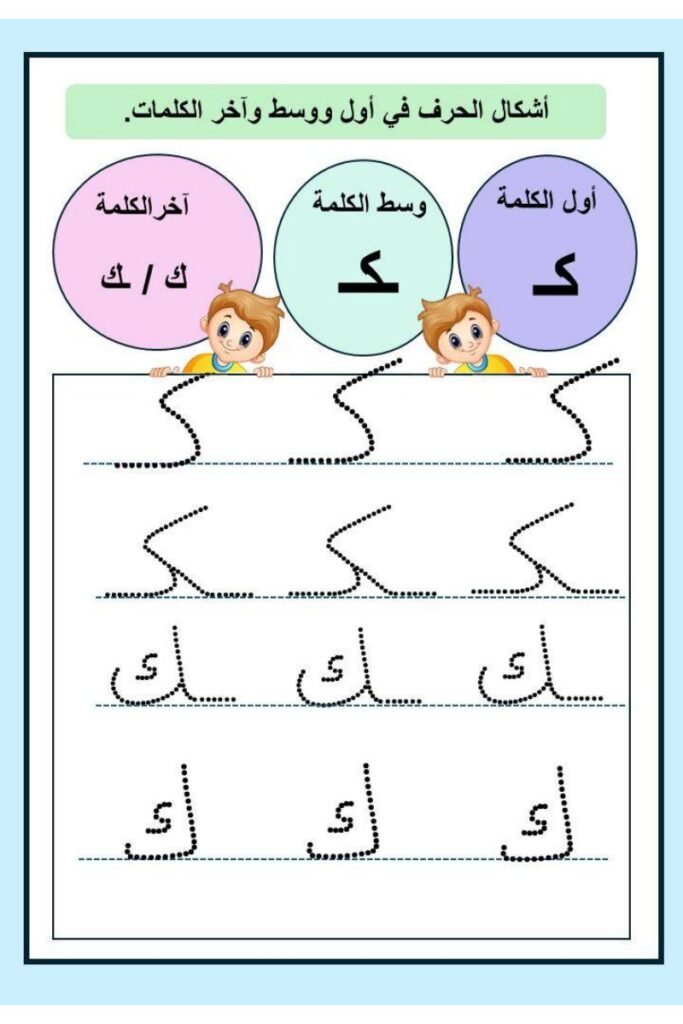
Arabic cursive handwriting worksheets for kids provide an essential, focused penmanship foundation to help early writers navigate the fluid structural shifts of connected Arabic script. When moving beyond isolated letters, young learners frequently struggle with how letters change depending on whether they sit at the beginning, middle, or end of a word. The printable Unit Four Handwriting Workbook isolates six vital, visually complex characters: Daad (ض), Ayn (ع), Kaaf (ك), Khaa (خ), Yaa (ي), and Dhal (ذ). For young kids, practicing these positional transformations on clean, guided dashed lines builds fine-motor muscle memory, stabilizes baseline control, and reinforces accurate dot placement.
Connecting clear positional reference circles with repetitive dotted penmanship rails makes cursive writing intuitive and steady. Here is why dedicated cursive practice sheets form the ideal foundation for early Arabic writing fluency.
Why Choose Arabic Cursive Handwriting Worksheets for Kids?
Practicing regularly with Arabic cursive handwriting worksheets for kids delivers distinct developmental advantages:
- Demystifies Complex Cursive Transformations: Illustrates dramatic anatomical shifts—such as how Kaaf transitions from its open initial zig-zag to its enclosed final form.
- Reinforces Non-Connecting Letter Rules: Highlights letters like Dhal, teaching children that it joins preceding letters but never attaches to succeeding ones.
- Eliminates Dot and Baseline Confusion: Differentiates similar characters through careful dot counting, contrasting Daad with Saad, and Khaa with Haa.
- Builds Fine-Motor Coordination: Features 72 total dotted tracing models across four guided baseline rails, encouraging steady hand posture and uniform sizing.
Inside This 6-Letter Kids Penmanship Pack
Designed thoughtfully to balance playful discovery with structured foundational benchmarks, this printable booklet delivers comprehensive support:
- Six Targeted Letter Worksheets: Dedicated full-page activity sheets methodically isolating Daad, Ayn, Kaaf, Khaa, Yaa, and Dhal.
- Color-Coded Visual Position Keys: Distinct header circles showcasing the character’s appearance across initial, medial, and final cursive variations.
- Repetitive Dotted Tracing Rails: Four ruled rows providing 12 guided stroke repetitions per page to establish natural pencil flow.
- Ready-to-Print Classroom & Home PDF: An ink-conscious, zero-prep layout engineered for kindergarten morning desks, homeschool penmanship, or remedial intervention.
Practical Home Tips for Handwriting Success
To make cursive tracing a cheerful, confidence-building routine with your learner, try these creative parent tips:
- The Finger Air-Trace: Model the stroke direction on paper, then have your child trace the cursive shape in the air before putting pencil to paper.
- The “Check the Dots” Step: Prompt kids to inspect each completed line, verifying whether the dot sits above (Daad, Khaa, Dhal) or below (Yaa).
- Break It into Two Daily Rows: Prevent wrist strain and preserve neatness by having your learner trace two lines in the morning and two in the afternoon.
Images from Arabic Cursive Handwriting Worksheets for Kids
Arabic Cursive Handwriting Worksheets for Kids: The Unit 4 Letter Forms Guide
For easy, free direct downloading, the memorandum was also displayed in PDF format. We presented this file to you from the kidslearningarabic blog If it indicated that there was an error. I hope you will leave that in the comments below.
Read also in Arabic: Arabic Cursive Handwriting Worksheets for Kids: The Unit 4 Letter Forms Guide