
Mastering Arabic non-connecting letters for kids is one of the most critical breakthroughs in early literacy, directly preventing over 80% of beginner spelling and cursive handwriting mistakes. In Arabic, most characters are naturally social—they extend connecting arms to join hands with the letters before and after them. However, six unique characters break this pattern: Alif (أ), Daal (د), Dhaal (ذ), Raa (ر), Zaay (ز), and Waaw (و).
Variously known in elementary Arabic pedagogy as “pushing letters” (Al-Huroof Al-Raafisah), “mischievous letters” (Al-Huroof Al-Shaqiyyah), or “one-way connectors,” these letters happily hold hands with whatever comes before them, but refuse to join hands with whatever comes after. For young kids, learning this simple, playful rule eliminates endless handwriting confusion and empowers children to read and construct words with total confidence.
Framing one-way cursive rules through memorable storytelling transforms an abstract orthographic concept into a fun puzzle. Here is why understanding non-connecting letters serves as the essential bedrock for kindergarten and primary Arabic literacy.
Why Choose Arabic Non-Connecting Letters for Kids?
Practicing regularly with Arabic non-connecting letters for kids delivers distinct orthographic and cognitive advantages:
- Eliminates Over 80% of Early Spelling Errors: Prevents emerging writers from mistakenly connecting following letters to Alif, Daal, Dhaal, Raa, Zaay, or Waaw.
- Clarifies Word Boundaries & Spacing: Teaches children how words maintain natural spacing and visual balance even when broken by non-connecting characters.
- Child-Friendly Storytelling Framework: Replaces technical grammatical jargon with engaging character concepts like “the friendly letters with only one hand.”
- Accelerates Fluent Reading Speed: Trains young eyes to recognize letter clusters quickly without stumbling over intentional gaps inside a single word.
Inside This Kids Pushing Letters Guide & Activity Pack
Designed thoughtfully to balance playful discovery with structured foundational benchmarks, this printable volume delivers comprehensive support:
- The 6 “Stubborn” Letters Spotlight: Dedicated visual breakdowns for each one-way connector—أ, د, ذ, ر, ز, و—contrasted against regular connecting letters.
- Visual Handshake Diagrams: Intuitive illustrations demonstrating the “one right hand” rule: connecting backwards, but keeping an open space forward.
- Contextual Word & Picture Rails: Clear vocabulary pairs illustrating the letters in initial, medial, and final positions (such as Asad, Daroor, Wardah).
- Ready-to-Print Classroom & Home PDF: An ink-conscious, zero-prep digital format engineered for elementary writing centers, morning drills, or homeschool review.
Practical Home Tips for Non-Connecting Letters Success
To make the “pushing letters” rule an active, unforgettable daily lesson with your learner, try these creative parent tips:
- The “One-Handed Hug” Game: Stand side-by-side with your child and practice extending only your right arm to hold hands, while keeping your left arm tucked in to act out a pushing letter.
- The “Kick and Push” Sound Effect: Whenever your child writes a letter after Alif, Daal, Dhaal, Raa, Zaay, or Waaw, make a funny playful “boop!” sound to remind them to leave a tiny space.
- Color-Coded Letter Spotting: Have kids highlight the 6 non-connecting letters in bright yellow within a printed story before checking whether they correctly left a gap after each one.
Image from Arabic Non-Connecting Letters for Kids
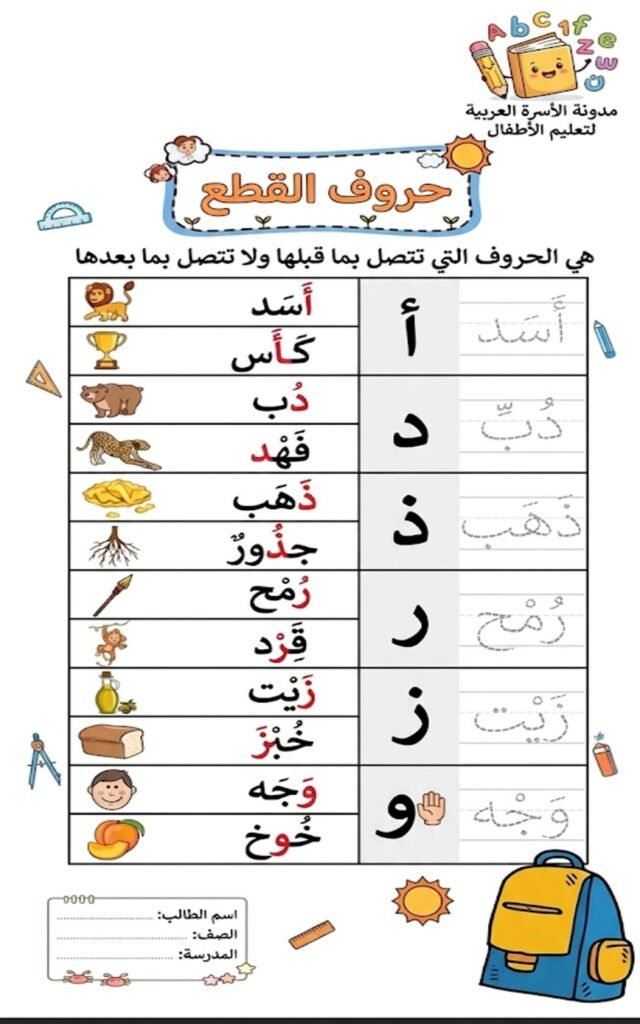
Arabic Non-Connecting Letters for Kids: The Friendly Guide to “Pushing Letters” (Al-Huroof Al-Raafisah)
For easy, free direct downloading, the memorandum was also displayed in PDF format. We presented this file to you from the kidslearningarabic blog If it indicated that there was an error. I hope you will leave that in the comments below.
Read also in Arabic: Arabic Non-Connecting Letters for Kids: The Friendly Guide to “Pushing Letters” (Al-Huroof Al-Raafisah)
Hi,
I was checking your website kidslearningarabic.com , and saw you have a good design and it looks great, but it’s not ranking on Google and other major search engines.
With your permission : I would like to send you a SEO Proposal with prices showing you a few things to greatly improve these search results for you. These things are not difficult.
It will show you exactly what needs to be done to move you up in the rankings dramatically.
May I send you a best quote?
Thanks,
Jasmin Kaur